
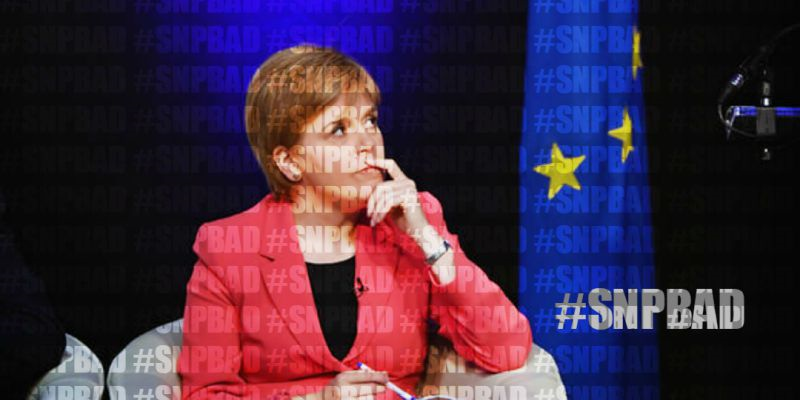
As we are all consumers of the media in Scotland we are all aware of the incessant hostility in the British media to the SNP and the independence movement. What we are perhaps not fully aware of is how this is affecting us subconsciously.
Have you ever wondered why the SNP, Scotland’s party in government, always seems to have such rotten luck? Recently I was out to coffee with a friend, a committed Yesser and onetime contributor to the Butterfly Rebellion. She looks at me and says: “Isn’t it odd the SNP always appears to be having an atrocious run of luck?” Choking on my non-fat Frappuccino with extra whipped cream and chocolate sauce – I jest, it was just a filter brew – as I exploded into a rant. My frustration wasn’t so much that someone had framed it like this, but that my first response was to nod and agree.
Kezia Dugdale has been given the boot by Corbyn because she couldn’t be trusted, a group of – not one or two – Conservative councillors have been readmitted to the ranks of the party by Ruth Davidson after being put out for open racism, and anti-Catholic bigotry, and comedians are on the dole queue all over the continent because our European neighbours are just tuning into Brexit for belly laughs. We are yet to hear the British media describe any of this as a crisis.
It was nothing more than a “shock” when Dugdale handed in her resignation. It wasn’t anything that couldn’t be handled, couldn’t be perfectly stage-managed by the BBC and Labour’s spin-doctors. There was nothing to see here. Everything from anti-Traveller and anti-immigrant racism to vile sectarianism was whitewashed by the Scotsman newspaper. It was reduced to nothing more than a “Twitter row.” Then there’s Brexit. It couldn’t be going better. So long as nothing is said about the capital flight to Europe and the collapse of the pound, everything is ticking along quite nicely.
Not so for the SNP. When the British media turns its attention to the “nationalists,” nothing can appear worse. Everything the Scottish government – “the SNP government” – has done to make rail travel in Scotland the best performing rail network in the United Kingdom, well that’s a “crisis.” There’s an NHS crisis in Scotland too, an oil crisis, and an employment crisis, and any other flavour of crisis you may care to imagine. Scotland, thanks to the SNP, has become one big crisis.
Yesterday it was rail chaos, NHS crisis and the HARDEST GEOGRAPHY EXAM EVER! What will the BBC drag out the SNP bad box today?😁
—
Lucas Quirrel (@Riddok1) November 23, 2016
When leaves fall on the tracks, delaying trains; that’s a crisis. When the Scottish government prioritises funds for certain areas; depriving others, so as to mitigate London’s austerity regime, that too is a crisis. If an MP is asked to resign in the face of spurious allegations manufactured by the press – the SNP is again in crisis. It’s enough to convince you the British government and its lapdog press have it in for the Scottish Nation Party… oh, I see.
So when we’re out to coffee talking politics – as we do – we have a default setting on the SNP. The Scottish government is in crisis. It’s always in crisis. Sure, it’s had such a run of bad luck, and to some extent we all subconsciously subscribe to this narrative. Who can blame us? In a Britain where broadcasting has not been devolved to the national parliaments everyone is continually subjected to a constant, low-level drone of pro-London propaganda, and as long as the devolved governments bend the knee to whosoever the Downing St overlord happens to be, everything is dandy.
The problem here is that the SNP hasn’t really been in the business of kowtowing to the demands of London. In fact it has gone that wee bit further by having the audacity – the bared faced cheek – to suggest that Scotland would do better without London. By doing this and continuing this talk of independence the SNP has become a dangerous threat to the security and stability of London’s UK, and in response the political establishment and the unionist media – the only media – has gone down the road of poisoning the waters, infesting everything we consume in the media with a sometimes subtle, sometimes obvious hint of “SNP bad” wormwood.
Thanks to the work of a number of blogs in the independence movement – some infinitely better equipped than I at media analysis – like Wings and IndyRef2, we are beginning to get our heads around the wholesale manipulation of public consent in the UK, but we have a long way to go. It is happening already in some places, but we need more grassroots media awareness fora and workshops. This isn’t the sort of stuff we can leave to chance or to the expertise of a handful of intellectuals. Media – Britain’s media war against the SNP and the independence movement – affects us all, and so it falls to all of us to educate ourselves. We have to be a movement of analysists.
As an afterthought, it strikes me as particularly odd that media awareness or media studies – whatever you call it – isn’t a staple in our schools. The internet and social media, quite apart from the politics of Scotland, has fundamentally altered our perceptions of ourselves, our communities, our “networks,” our country, and indeed the world.
Doing media is what we do. It is inescapable, and yet, unlike what we are taught in school to do with literature and art, we have a surprising blackspot when it comes to thinking through and understanding some of the basics of how media works and influences us. This is something all of us – everyone on the planet – should be thinking about. We have a responsibility to safeguard our democracy, and this we can do by learning how it is being undermined by an increasingly media savvy hidden state apparatus.
Another SNP Bad discussion on the Politics Show
You can follow Jason Michael at his twitter page @Jeggit or at his webpage The Random Public Journal
Jason Michael is a Scottish journalist and blogger based in Dublin. Writing on politics and society. Columnist for iScot Magazine and author of the Random Public Journal.