
For the past two years I have built this blog into an outlet where Scots could consider their future options in geopolitical terms. The need became acutely aware as the 2014 referendum on Scottish Independence came and went and with the integrity and reach of the British state in decline. The independence movement awoke the existence of Scotland as a state and a sense of discussion about what Scotland was and how it could conduct itself on the global stage.
.
Regardless of the health of such a movement, I still feel this effort is worthy of time and investment and especially given the Eurocentric nature of foreign policy debate in Scotland. History is a vital part of such a discussion as our past subconsciously and consciously informs our attitude and actions regarding the objective nations. Those are nations outside the European imagination which have suffered external cajoling and aggression to a far greater degree than our own.
.
Often the historical and political can be better emphasised when reduced to the personal. The case of a Scot in Qajar era Iran provides us with a lesson in Scotland’s role in empire, the function of its professional class and its relevance to today. In the past fortnight, I took part in an event which covered the legacy of empire building for our cultural institutions and Scotland’s role in that construction. The Empire Cafe which launched in 2014 in response to the Commonwealth games has constantly tested the limits of what Scotland’s political and popular memory has allowed regarding empire and justice.
.
The Iranians may have had the “English” as their uniquely marked and detested feringhee throughout the 18th and 19th century. But to many around the empire “the English” was a term describing as many professional and military Scots or Irish who served in the “near East” or the bureaucracy of the Raj. Scots were invisible as their collusion in the empire had robbed them of existence and conscience.
.
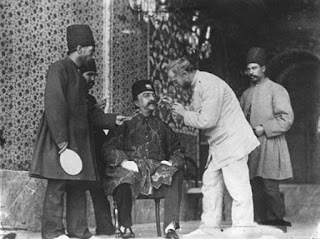
The story of Major General Sir Robert Murdoch Smith, a Scottish engineer, diplomat, archaeologist and military man is one of adventure, scholarship, trade, thrift but ultimately and typically pillage and empire. Smith grew up in Kilmarnock in 1835 and attended Glasgow University, that established groomer of imperial men, and would go on to be an agent for the Department of Science and Art in Iran where he reported on and acquired collections of Iranian objects for the South Kensington Museum then to be the Victoria and Albert.
.
After being commissioned in the Royal Engineers in 1855 he undertook archaeological expeditions to Asia Minor and North Africa, and published two accounts of his travels. For 20 years he was director of the Persian telegraph company in Tehran, a position that gave him unrivalled opportunities to develop relationships with collectors and dealers, and to scour the markets for artefacts. This way he could “acquire” plenty of pieces at good prices from areas of Iran sending them back to London for examination and collection.
.
There’s a long history of Scottish involvement in Middle East-European commerce especially at a time when building on it’s holdings in India, the UK wanted to establish more secure trade and political links to the Raj. Both Iran and Turkey seemed the ideal locations but the Ottomans at this time were a firmer proposal and unlikely to be bullied or seduced into unbalanced commercial ventures and diplomatic arrangements.
.
Persia, the name by which Westerners called Iran, was a different matter and as the country’s Qajar dynasty – which ruled Persia from 1785 to 1925 – sought steady technological improvements the British empire found an opening. This was in fact the way Murdoch Smith found himself in Iran responding to an advertisement by the Persian telegraph firm seeking those with the technical expertise needed to improve lines of travel and communication.
.
Yet the British would not be there simply for the charitable notion of improvement. Naturally the opening up to the West meant improvements in economic development but also resulted in a sharp surge of British strategic communication within the Persian political system. This in the long term would partly lead to the overthrow of the Qajar dynasty by Reza Shah in 1925.
.
The British had an erratic relationship with the Persians but wars with Napoleon in the “Near East” and the eternal battle with Russia for control of security around India compelled Britain to take a closer interest in the internal workings of Iranian politics. The same anti-Russia fear or in later cases anti-Soviet & Germany fear would lead British Governments to intensify Anglo-Iranian trade from the 1920s onwards until the 1979 revolution.
.
During the mid 1800s the shah, Mohammad Shah Qajar, launched campaigns into Afghanistan convincing the British that Iranian control of Afghanistan would bring Russia to the gates of India. These years would see British merchants use funds to prop up shahs, bring down shahs and grow garrisons in India as warnings to Persian rulers.
.
These political contexts are important to note when considering the story of Scots such as Murdoch Smith who have been noted as a benefactor to Anglo-Iranian relations. It is true that the Scot contributed heavily to the resurrection of interest in Persian culture, art and literature. This had been on the wane in Britain since the political and cultural classes had been busy during a period when the Victorian mind treated Hindu culture and art as a type of fetish.
.
The Scot witnessed enlargement of the urban area of Tehran under the patronage of Nasir al-Din Shah. The rapid construction of new mosques, gardens, mansions and public buildings would have been an exhilarating sight and Murdoch Smith made contacts with famed Persian artists like the tile maker Ali Muhammad Ishafani.
.
His seven years in Iran meant that the South Kensington Art Museum could put on a show in April 1876 with 3,517 objects on shows. Arms, armour, carvings in wood and stones accompanied a catalogue written by Murdoch himself much to the glorification of the London Times.
.
Adventures such as these, however, came at the price of political stability and an equality of development in Qajar Iran. There is an ethical question about Western museums build up their collections of ancient and contemporary Iranian art work whether by purchasing or pillaging. In this way we can consider Murdoch Smith’s acquisitions as a form of soft pillage. No doubt he had much love and affection for Persian culture but there is the issue of eastern art needing western validation and validation only by bringing it to a western academic and popular audience.
.
This passage written in his private letters captures this mixture of aloof superiority and admiration of the Persians.

Others may state that Iran got a good deal. A spurt of development and quality engineers from Europe in exchange for opening up trade and selling of artefacts. That may too be considered a neo-colonial argument.
.
Non-European powers have always been required to yield on European terms or to be judged on the cultural standards of the West. After such examination, albeit well intentioned, the patient maybe considered civilised to be dealt with gently. In many ways the rules have not changed in today’s artistic or political spaces.
,
The invisible Scotsman may have been a great admirer of Persian art and an active scholar but we can not separate the international context in which he operated. He created opportunities for audiences in Europe to see Persian tile work, textiles, sculpture, metal work and more. Artists “restricted to the steps of the Near East” in his words found custom through his contemporary art deals. But a military academic can leave a mixed legacy.
You can follow Robert J Somynne on twitter at @RobertJSomynne and at his blog robertsomynne.blogspot.co.uk