

Between the 27th June to the 18th July the Art Village is hosting an exhibition of one of it’s artists in residence. Bill is a regular attraction for the Creation Space, as he’s painted by the window – to make use of the excellent natural lighting – most weekday afternoons for the past four months. He is a quiet, self-contained man, but always willing to listen and talk to those who come in to watch him work. I’ve been able to record the progress of a few pieces of his work, so today, rather than taking photographs, I just sit to the side and we talk while he paints.
Bill’s a Glaswegian, who’s artistic talent was initially appreciated by Miss Mossman, a teacher at Centre Street Primary School, Tradeston. He talks of her with a warm affection, but says that she owes him. Whereas all the other children would have to stop their art for other subjects, Miss Mossman would encourage BIll to finish, and then send him round the school to show his work, resulting in him falling behind his classmates in other subjects.

Seascape Oils on canvas
His family then moved to Priesthill when he was nine years old. He says, when talking about his school life, that he “doesn’t know if you can call it education” and that “art was the only thing that got him through it”. Once he left school BIll went to work at the Evening Citizen on Albion Street, doing “all sorts of things” for a few years, before becoming an apprentice joiner, and then later setting up his own joinery business.

Bill Limond with his art
During this time he studied at the School of Art, concentrating on portraiture, and visiting Kelvingrove to study the old masters and painters of the day. A favourite for him was the work of Sir Henry Raybourn, Scotland’s first significant portrait painter since the union to remain in Scotland. Bill explained he admired how Sir Henry painted directly from life, without preliminary sketches. At this time, Bill was able to set up his own studio in Renfrew Street, but this came to an end due to family commitments.
He was able to spend time in the summer sketching tourists and holidaymakers in a range of lovely locations such as Paris, Barcelona, and then, closer to home, holiday camps in Blackpool, Wales and Ayr. He says that those times were invaluable in his education even though some times he would realise the sketch that holidaymakers had paid him to do, was not going to plan. At that crucial point, he would excuse himself rapidly, exit whatever pub he found himself, and leave his sketch pad, and his unfinished work, behind. It was either this or face the wrath of, often slightly-intoxicated, unhappy customers. And no, he didn’t run off with the money!
Once his family had grown up, he gave up the joinery and went back to painting full time. However, as he didn’t intend to be a typical penniless artist, he also trained as a hypnotist, and uses his stage career to supplement his income.
In his current exhibition, he shows three of his very different styles.
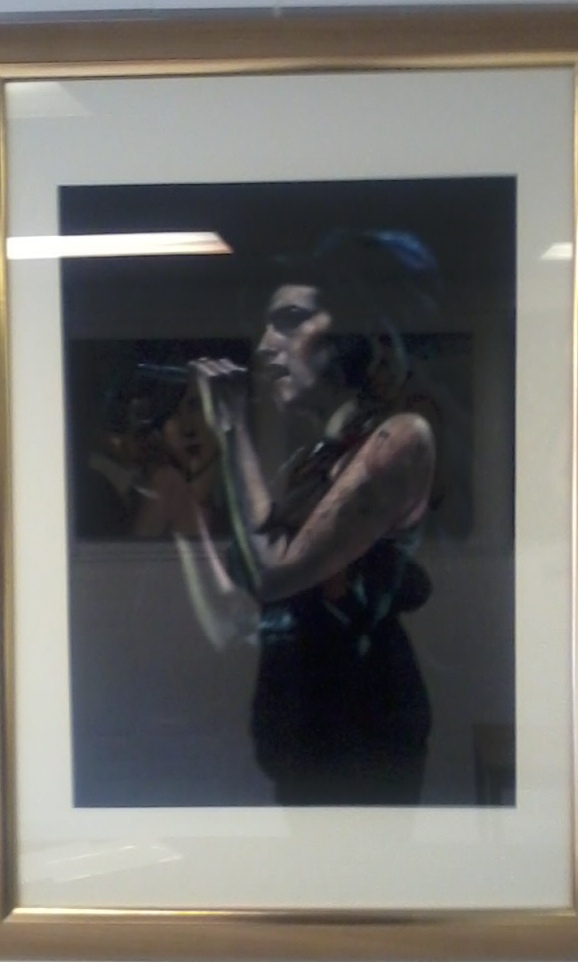
Amy Winehouse Oils on velvet
The first is his fantastic tributes to Polish Art Deco painter Tamara De Lempicka: “the first woman artist to be a glamour star”. When asked why he’d chosen her for inspiration, he said he had been asked to produce some Art Deco style work for a house renovation. He researched some of the artists of that period and was instantly captured by her style. Up to that point he hadn’t heard of her and didn’t realise the degree of her popularity.
Bill states:
“I started to really admire her work and character, and wanted to pay tribute to her.
Tamara loved life but was frowned upon because of the quality of her work. She didn’t care if her paintings were a bit “below the belt” and I think that’s what I like most about her.”
The second is his “Rock Star Portraits” which are all painted on velvet. He started doing these whilst at the School of Art, and confides that his lecturer was quite disapproving. Bill explains he started doing them as a similar work once caught his eye in a gallery and he wanted to see if he could do it. I know from my time in Art Village that many people enjoy them and that they are probably one of his best sellers.
The final of his three styles on display is his seascapes. These are the ones you feel he enjoys doing the most. He points out that he doesn’t paint actual landscapes, but just what his imagination conjures up. Bill says he finds the creative freedom of being able to paint just what he wants, quite relaxing, and he says it doesn’t matter if he adds an addition rock or changes the clouds. He is free to do as he pleases.
In the months I’ve known him, it is only now when talking about the seascapes and the depth of colour in his work, that I heard the first hint of vanity from him. He smiles and says blending the colours comes naturally, “I’ve never had any trouble, I just know what I want and I can blend it”.
At this point in the conversation, two of our customers approach, guys in their twenties, and they start, as so many do, with the story that a friend has one of his portraits. In this case it was an Elvis on velvet. And, as usual, the worst kept secret in Shawlands is raised: Bill is Limmy’s dad, yes THAT Limmy. He makes us laugh saying how he would have skelped his legs if he’d behaved like that as a child. The two guys leave, still laughing at the other story, which I won’t tell, and Bill returns to his painting.

Simone Charlesworth
you can follow simone on twitter @cee4cat